

-
- Same-sex marriage Mayor Gavin Newsom poised for second term
- No tricks or treats at annual street party in the Castro
- Michigan case centers on gay workers’ benefits
- Church ordered to pay $10.9 million for funeral protest
- Gays still barred, army marks record low level of recruits
- Lambda Legal helps former LAPD sergeant reach settlement
- National News Briefs
- World News Briefs
health & sports
Fit for Life
Understanding overtraining
Published Thursday, 08-Nov-2007 in issue 1037
According to Balanced Body, “the world leader in Pilates equipment and information,” participation in the Pilates method grew from 1.7 million in 2000 to 10.5 million in 2004. Once an exercise modality sought after by celebrities and other elite fitness enthusiasts, Pilates has now become a mainstream approach to getting fit. Often thought of as a method of training sinewy, flexible dancers, Pilates is a challenging workout for an exerciser at any level. According to Portia Page, Balanced Body University Faculty and STOTT PILATES® certified instructor and co-owner of BPG Bodies in Hillcrest, “Pilates can transform the way your body looks, feels and performs. It builds strength without excess bulk, creating a sleek, toned body.” But what exactly is Pilates, and is it something you should try?
The beginning
“The Pilates method was developed 80 years ago by Joseph H. Pilates, who was inspired by yoga and many other forms of exercise such as boxing, body building, martial arts and gymnastics,” says Page. Originally from Germany, Pilates was eventually interned in an English camp during World War I because he was considered an enemy of the state. During that time, he began practicing a method of maintaining his fitness, and shared his knowledge with fellow internees. According to the Balanced Body Web site, an influenza epidemic spread throughout the camps; however, none of Pilates’ practitioners were affected. Pilates firmly believed that it was continuous practice of his method that had helped keep the internees strong and capable of withstanding the deadly strain. Eventually, Pilates was released, and he continued to refine his method and began instructing others in Germany before moving to the United States in 1926. The Pilates Method—then called Contrology—became increasingly popular as more and more practitioners became instructors and opened studios all over the country.
What is Pilates?
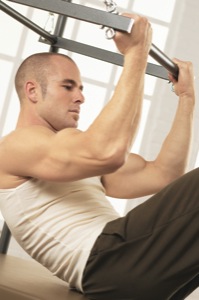
Said to improve posture, flexibility, strength, mobility and “economy of motion,” many Pilates enthusiasts are said to have begun practicing due to some sort of chronic or acute injury. A world-renowned back surgeon from New York is said to “prescribe” Pilates to his clients because he has witnessed greater success from regular practice than from invasive surgeries. “Pilates mainly concentrates on core strength and lengthening the spine,” says Page. Considered a “mind-body” exercise, in which careful concentration must be placed on the body and its movements, Pilates also focuses on breath work for stabilization, centering, control, flow and precision. Often confused with yoga, Pilates is more movement-oriented and can be performed on a simple mat or equipment such as the Cadillac, Reformer, Wunda Chair and other iterations of Joseph Pilates’ original designs. For those manly men out there who scoff at the thought of participating in such a “wussy” program, you might want to think again. “These days don’t think that there are too many things or activities that are ‘just for girls’ or ‘just for guys,’” insists Page. “Considering that the person that developed Pilates was a man, I would say that Pilates is not just for girls! It’s an exercise modality for every body.”
Speaking from my own experience (and a bit of study underneath Page), I humbly concur that Pilates is a very demanding practice that makes even the most weighty of dumbbells seem wimpy.
Where to practice.
Pilates studios abound in the San Diego area, but gym-goers are also likely to find some form of Pilates on the group fitness class schedule. Due to space constraints and equipment costs, you will typically find that the basic gym only offers Pilates mat classes, while more upscale establishments also offer equipment-based classes. For a challenging, yet positive experience, Page suggests students sit near the front of the class until they feel comfortable with the movements. It is also suggested that new students alert the instructor that they are just beginning practice, so the instructor can supervise against any injury. Page also believes that matwork is a great way to exercise, as it can be “done anytime, anywhere because only you and a mat are needed.”
If you’re looking for a more intimate approach, it might be a good idea to check out some local Pilates studios to gain one-on-one, partner or small group training. This way you gain more individualized instruction that is arranged around your current capabilities and unique structural makeup. “If you are completely new to exercise, I would suggest a private session with a trained professional,” says Page. “The movements of the Pilates method are very precise and controlled, yet the subtleties and nuances of the movement can be lost on a person new to exercise. Working with someone one-on-one will help you become more aware of how your body moves and how to move correctly.”
Choosing an instructor.
According to the Pilates Foundation, when selecting an instructor, be sure to ask some valuable questions before purchasing sessions. Because there are a variety of “certifying bodies” out there, it is very important that you ask about the instructor’s credentials, how long he’s been teaching and how extensive his training was. There are many people who decide to become certified Pilates instructors and do so online or through a weekend certification course. As Page mentions, the nuances and subtleties of the method require a keen eye and the ability to modify, if needed, and weekend or online courses cannot properly educate potential instructors completely. This lack of education can lead to poor results, a negative experience and even injury. Search out an instructor who has undergone rigorous training from organizations such as, but not limited to, Balanced Body (www.pilates.com), STOTT PILATES (www.stottpilates.com) or the Pilates Method Alliance (www.pilatesmethodalliance.org). Each organization offers a database of instructors to make locating one in your area a more time-efficient process. It is also wise to select an instructor who is capable of working with you should you have a back injury, chronic illness or other special consideration.
Get equipped.
Many private studios also offer equipment. “Because of its stability and height of the bed, the Cadillac is also very useful for people who lack stability and strength, yet it also allows hanging exercises which are more challenging and fun!” says Page. Perhaps the most recognizable piece of equipment, the Reformer is hugely popular due to its smaller size. “It is also extremely versatile, offering exercises for the beginner and challenging those advanced students,” she adds. And finally, the Wunda chair is another option for enthusiasts. “While the chair looks unassuming, it can be very unforgiving, yet functional for most exercises.” Page believes that the Wunda chair is a great option for larger persons or women who are pregnant as similar exercises performed on the mat or other pieces of equipment may prove too difficult.
Whether you’re looking for an alternative to traditional strength training, or a supplement to your current routine, Pilates can offer many benefits that go far beyond strong, pliable muscles and a more sleek-looking physique. Not just for celebrities, supermodels and elite athletes, Pilates is widely available and is suited for persons of all shapes, backgrounds, interests and abilities. If you’ve not yet given Pilates a try, now may be the right time. Just like so many others, you might even go back for more!

|
|
Copyright © 2003-2026 Uptown Publications