


-
- Court weighs gay Long Island man’s right to sue in partner’s death
- Key military specialists discharged under ‘don’t ask, don’t tell’
- Internet ads go after vice president’s lesbian daughter
- Massachusetts governor urges constitutional ban on same-sex marriage
- Study: Gays and lesbians over 50 involved in family caregiving
- San Francisco’s same-sex wedding march inspires documentarians
- Judge postpones hearing on women’s application for marriage
- Arkansas Pride continues despite protests
- National News Briefs
- World News Briefs
san diego
Former San Diego go-go boy arrested for murder
Two brutal Hollywood murders have San Diego ties
Published Thursday, 01-Jul-2004 in issue 862
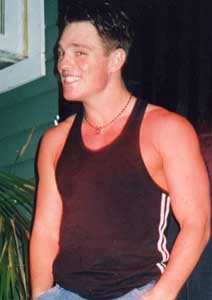
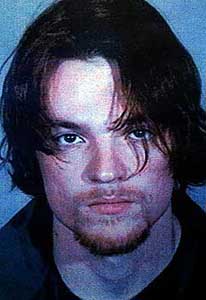
Two recent, brutal murders of a 91-year-old screenwriter and a 69-year-old doctor in Hollywood have ties to gay San Diego. Keven Lee Graff, the 27-year-old who has been accused of beheading screenwriter Robert Lees and then stabbing to death his neighbor, Dr. Morley Engelson, on the morning of June 13, was a fixture and a go-go dancer at local gay clubs and circuit parties between 1997 and 2002, at which time he reportedly moved to Orange County.
Graff was arrested on June 14 near the gates of Paramount Studios, about two miles from the victims’ homes. Associated Press reports say that guards at the front gates of the studios noticed erratic behavior from Graff, and reported that he was talking to himself and yelling at cars. Reportedly, one guard recognized Graff’s picture from a televised news conference that had just aired, and his supervisor called police. Police reports and national news reports described Graff as a “transient”, and he had reportedly lived out of his car during the three months preceding the murders.
Police found the body of Engleson after a Southwest Airlines ticketing agent called police and reported hearing a commotion break out while he was trying to book a flight over the phone. At Engleson’s home, police found the head of Lees along with some other items that had been taken from his home.
Lees was a screenwriter who had worked on a number of films, including Abbot and Costello Meet Frankenstein. The Associated Press has reported that during the “Communist scare” of the 1950s, Lees was blacklisted, but went on to write under the name J.E. Selby, according to the Writers Guild of America. He had several film and television credits, including episodes of “Rawhide” and “Alfred Hitchcock Presents”.
A friend who had gone to check on Lees found his body in his home.
“This is one of the most horrendous crime scenes that I have seen during my 33 years as a police officer in this city,” Detective Brian Tyndall, one of the lead investigators in the case, told the Associated Press. “Very bloody.”
Graff was also believed to have stolen Engleson’s black Mercedes-Benz that was later recovered.
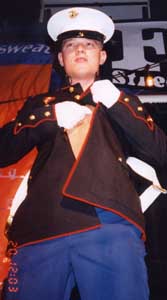
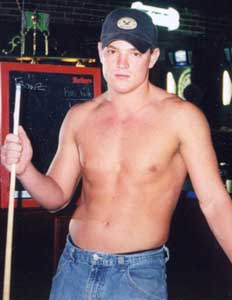
National news coverage has portrayed Graff as the all-American kid while growing up. He played football and baseball in high school and then joined the Marines after high school at which time he was assigned to Camp Pendleton. While stationed at Camp Pendleton, Graff contacted local events producer Anthony Cortez of Foreplay Productions and was hired by the company as an exotic dancer. Graff became a popular fixture in the San Diego club and bar scene, where he was generally regarded as good looking, nice and down-to-earth. Graff was featured on an April 2002 Gay & Lesbian Times cover in an issue looking at the circuit party scene. Graff’s sexual orientation was a mystery, and remains so. News of Graff’s alleged role in the Los Angeles murders has surprised people in San Diego’s GLBT community who knew him as a dancer.
In a phone interview, Foreplay Productions’ Cortez told the Gay & Lesbian Times (GLT) that, during Graff’s interview process Cortez explained to him that a lot of the company’s work was done with San Diego’s gay community. According to Cortez, Graff said that he would not have a problem with that and Cortez said that Graff claimed to have a girlfriend at the time.
According to notes obtained by the Gay & Lesbian Times (GLT) and made by Cortez during Graff’s initial interview, Graff said he would be willing to do the following: “Private parties, video work, promotions and clubs. Will dance for gay men and escort.”
According to Cortez, while Graff did fine fulfilling his obligations as a dancer, he was depressed.
“I think as he got more and more comfortable with the gay community he opened up more as far as dancing in the bars and letting guys tip him,” Cortez said. “He even got closer with some of the dancers who were gay. I know of more than one incident where he stayed over at one of the other guy’s houses. They didn’t have sex or anything, but I know that they had cuddled and he liked that, I guess he felt safe with that.”
At the same time, Cortez said Graff was looking for ways to get out of the military.
“He was really depressed because he wanted to get out of the military and they wouldn’t just let him out,” Cortez said. “He didn’t know what to do and he didn’t want to get a dishonorable discharge. He would confide in me and tell me that sometimes he was suicidal, like he really wanted to get out of the military.”
According to Cortez, Graff developed a relationship with local event producer Bill Hardt, whom Graff met at a male exotic dance competition that was held at Club Montage.
Cortez said, “He had somewhat of a relationship; he ended up moving in with Bill Hardt.”
Hardt, who limited his comments on Graff, did say on the record that he knew Graff from 1997 to 1998. Photos posted on Hardt’s business website show the two on Hardt’s Powerhouse Productions Pride float together as recently at 2002; and Foreplay Productions, the company that handled Graff’s bookings, provided the Gay & Lesbian Times with copies of contracts dating back to 1998 and signed by Hardt, Cortez and Graff, engaging Graff as a dancer for Pride-related parties for Hardt’s company, Quantum Entertainment.
Cortez also said he introduced Graff to another acquaintance that Graff lived with for a short time.
“I had introduced him to another gentleman, his name was Steve, who was a business owner; you know, well off,” Cortez said. “He lived in La Jolla and this guy was known to hire escorts and I was basically the one who turned him on to him. I know this gentleman liked young boys and what he was into was bondage and in the beginning I know he developed a relationship with Keven and Keven moved in with him.”
According to Cortez, Steve denied that the relationship was ever sexual. Graff eventually stopped working with Foreplay Productions and Cortez said Graff told him that he was moving to Orange County and planned on getting out of the scene.
“This was a total angel sweetheart,” Cortez said about Graff. “No attitude. … He never did drugs and when he worked at the bars he would not drink alcohol, he would drink water. He was really focused on training and building up some muscles because when he started working with us, that’s what we told him he needed to do. … He was just a great guy, very, very loyal to us, and after seeing all of this happen I couldn’t believe there wouldn’t be a connection with, if someone is going to go out of their way to do something that horrific, that there would not be a connection [between] Keven and the guy he did this to. But you know, his comment [to the Associated Press] was he was on drugs.”
According to reports published by the Associated Press, in an interview from jail, Graff said that a man on the streets of Hollywood gave him methamphetamine and Ecstasy the night before the slayings. He claimed that the next thing he remembered was being surrounded by police the day after the killings.
“You see, man, I’m such a good person,” Graff is quoted as saying in the interview. “I’m the guy who opens the door for old ladies. I wanted to be a positive role model for children.
“If I really did this, man, I just want to say I’m sorry; I’m so sorry. I know saying sorry isn’t enough. It isn’t going to do nothing. But I’m no criminal, dude. I’m really a good kid. I don’t know how this all happened.”
While living in Orange County, Graff worked as a personal trainer at a fitness center, living with girlfriends, friends and his half brother. He was arrested last year in Orange County for failing to pay a fine for a carpool violation and he has a half-dozen minor criminal violations, including a narcotics arrest in Long Beach and one involving alleged lewd conduct in Las Vegas, according to the Associated Press.
Reports also said that in July 2003 Graff was committed to a mental facility after he called Fullerton police and threatened to beat a man who he claimed had molested his girlfriend.
Since being released, detectives told the Associated Press that Graff drifted between apartments and spent time on the streets, losing 20 pounds. He eventually ended up in Hollywood, where he lived out of his pickup and on the streets.
The Los Angeles County District Attorney’s office has not yet decided on whether it will seek the death penalty. Graff was scheduled to be arraigned in Los Angeles Superior Court earlier this week, but the proceeding was postponed until next month at the request of his attorney, Deputy Public Defender Thomas Moore.
Outside court, Moore called the case “a terrible tragedy.”
Graff, who is being held without bail, said he resisted his family’s attempts to put him under psychiatric care.
“I just wanted them to leave me alone,” Graff told the Associated Press. “I was a lot of positive energy, but people would try to pull that positive energy from you. The more happy you are as a person, the more people want to take that from you. This Earth is hell. I’m just an innocent lamb. It’s up to God. He’s the only one who can judge. But really, I wish I could take what happened all back because I don’t understand this.” 
|
|
Copyright © 2003-2026 Uptown Publications