

-
- Same-sex marriage moves to top of election topics
- Domestic partner benefits involved in Proposal 2 debate
- Ohio Supreme Court rejects legal challenge to same-sex marriage
- Census snapshot of gay and lesbian service members and vets
- Schools should be kept out of same-sex marriage debate
- Mayor’s appointee resigns over New York domestic partner policy
- National News Briefs
- World News Briefs
san diego
Conversation and politics
Four active GLBT San Diegans have a pre-election conversation
Published Thursday, 28-Oct-2004 in issue 879
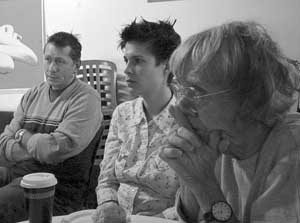
Forum participants:
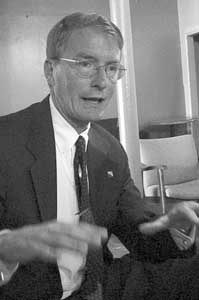
• Ben Dillingham, former chief of staff to Mayor Maureen O’Connor and chair of AIDS Foundation San Diego
• Abby Schwartz, special events manager for Fraternity House, Inc., founder of the weekly open-mic session Siren and a Gay & Lesbian Times columnist
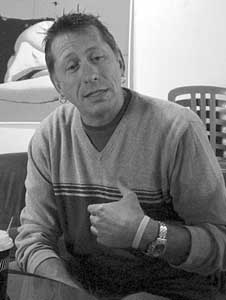
• Mike Phillips, co-founder of the nonprofit organization Ordinary Miracles
• Gloria Johnson, a longtime Democratic activist and delegate, currently working for Mike Aguirre’s city attorney campaign
GLT: It has been reported widely that there seems to be a lot more young people energized [this election season]…. How do you think this will affect the average GLBT person – a positive effect, a negative effect or not much effect either way?
Schwartz: I see a lot of young people totally energized to vote. I’ve never seen anything like this. When I was in college, even on campus I don’t think there was ever such enthusiasm and dedication coming from youth, and in terms of what I think the response or the results will be – I’m hoping for a positive. I think young people bring a really different perspective; I think young people bring a sort of freshness….
Dillingham: I think there’s a huge possibility for a downside based on the outcome of the election. I think if this election ends the way the last one ended, and if you have major reversals, such as Supreme Court appointments and that kind of thing happening, I think that all this youthful enthusiasm and energy and also participation by a broad spectrum of Americans… I think if you have a result that can be viewed cynically as the last one could be, and if there is a strong sense by the people of the United States that they were misled in their vote and in the course that the country is taking, I think the negatives could far outweigh the positives of what’s been generated by the closeness and the intensity.
GLT: How big is marriage as an issue in motivating a lot of these voters? And if it’s not very big, what is motivating them?
Dillingham: I think the marriage issue, as an item of motivation, has primarily motivated the conservative Christian vote as opposed to the opposite vote. I think that the broad spectrum of issues that are engaging in this election go far beyond the marriage issue. … I don’t think that’s what’s getting most people.
GLT: What’s getting most people?
Phillips: I think it’s terrorism, and the war.
Johnson: The economy.
Phillips: And the economy. I believe this administration has totally based its administration on fear, I think that’s been the message since Day One. Maybe there’s something to fear, but I don’t think the way that President Bush has done it is worthy of his reelection.
Dillingham: I think the other issue that certainly engages any voter that has a sense of history of this country, and a sense of the separation of powers, and a sense of the delicacy of what makes American democracy work, has to be profoundly concerned by the damage that’s being done to primary institutions…. Because I think the executive [branch] has taken a contemptuous view of both the judiciary and the Congress, and has gone forward deliberately misleading the Congress and also marginalizing the judiciary by saying that they’re not representative of the people. That is a false reading of how our Constitution put together the three separate powers that govern us, and the long-term effect of that is devastating. And I think those of us certainly who have fought for this country and who care deeply about its future and have invested greatly in it – that that is a primary concern beyond these individual issues.
GLT: Have these issues that Ben just outlined changed any of your minds about whom you want to vote for?
Johnson: I knew Bush was a disaster from the first time I heard him open his mouth, when he was running for Texas governor against a wonderful woman, Ann Richards. And then I was just appalled when he became president.
GLT: I’m going to switch to something more specific. What does everyone think about John Kerry’s comment about Mary Cheney in the recent debate?
Schwartz: Interesting. I thought it was a low blow. I had really mixed feelings about it. On the one hand, I thought it was a low blow, and … just a slick political trick.
Dillingham: Why is it a low blow? I honestly don’t understand why it’s a low blow. What in your context makes it a low blow?
Johnson: I agree with Ben.
Schwartz: I think it was almost in the way he held himself and the way he delivered it. It just seemed like he had this in his pocket and he was waiting for the opportunity to pull it out – at the same time I agree with it. There was something about it that was a little slimy, but at the same time politics is slimy.
Dillingham: Since the vice president and his wife in a campaign forum had actually raised the issue of their daughter being gay…
Johnson: And she certainly wasn’t closeted – she did outreach for Coors!
Dillingham: … and that’s why they basically had a difference of opinion on his [President Bush’s] policy, but because he was the president, they supported his policy, and since that was raised and that was on the table, it seemed to me that it didn’t cross any boundaries; no new ground was broken, no confidences were dispelled. I mean it was simply a basic acknowledgement that most gays and lesbians view their orientation as not being culturally or environmentally related. I mean, I don’t understand why that would be any different than saying that probably the Kerry children chew gum, or something. I can’t understand what crosses the line.
Johnson: If he’d said of the other Cheney daughter that she’s married and has three children, would everybody get all bent out of shape over that? No.
Schwartz: But didn’t it seem like it was a way of sort of bringing out there as their chance of saying, “OK, for any of you Republicans that didn’t know that it’s in your family, too, it’s on your side of the ballot as well” – to bring that out there?
Dillingham: Any Republican would have to be living under a rock to not know that the Cheney girl’s a lesbian. … If there was any reason at all for a gay, lesbian, bisexual, transgender person to vote the Republican ticket, that is probably the only reason that most of us could find to support this administration.
GLT: Is it necessary for the GLBT voting block to vote for the same party?
Johnson: [Laughs.] Well, Mike and I were talking about this earlier. Both parties have a philosophy. What Ben’s [been describing] is the philosophy of the current Republican Party. They do not support lesbian and gay rights. In California, Mark Leno, who is one of our openly gay legislators, from San Francisco, had two bills: Several years ago he had a domestic partnership bill – not one single solitary Republican voted for it; this year he had a marriage bill [AB 1967, the Marriage License Non-Discrimination Act], not one single solitary Republican voted for it. I mean, they’re not going to break ranks…. They’re going to be lined up like ducks.
Phillips: I think – and I respect Gloria, she has been around for a long time and I can’t even hold up to the knowledge Gloria has – but I think it’s OK. I think we have to educate Republicans sometimes that way. And I know that Gloria would say it’s not going to happen, but I don’t believe that. I’ve seen change in my own life, and … I think … maybe slowly change will happen. All this is a learning experience for me.
GLT: If you look at the 76th Assembly District race, the seat that Chris Kehoe is vacating, we’ve got Republican Tricia Hunter with Democrat Lori Saldaña, and we’ve had gay and lesbian activists and organizations on both sides of this race. What do you think of this?
Johnson: Lori’s 100 percent for our issues; she’s 100 percent on same-sex marriage, and I think she’ll be a good, solid vote on our behalf.
GLT: Mike, have you been involved in Tricia Hunter’s campaign?
Phillips: Yeah. I believe she’ll be good on our behalf, too – even though she is Republican. She’s pro-choice, she’s pro- environment, she’s pro-gay, and I think she’ll represent us well.
GLT: How is she pro-gay?
Phillips: … I go to a lot of benefits and a lot of meetings in this town, and I’ve seen Tricia at a lot of these functions, and … I know that she does go to Mexico and help in her own time; she shows a lot of compassion to people in general.
Johnson: I’d like to say, Ms. Hunter was in the Assembly in ’91 and ’92. At that time, on her voting record it was completely Republican. From the California National Organization for Women she received – out of a possible 100 points – she received [something] like 51 points. Her pro-choice was sometimes-choice. She did not support funding for abortions; she did support parental notification. So her so-called choice vote was very limited.
Dillingham: I do think you have to be somewhat fair in dealing with Republican candidates and recognize that there is a limit to the distance they can go in bucking their own party, and the same thing could be said for Democrats. … You hope to make a read of [a candidate’s] character. My one concern about Tricia is not on a gay and lesbian issue, but I am deeply disturbed by the racist element of the campaign ads that have appeared. And it’s interesting that one of her strengths is going down and helping impoverished Mexicans that have birth defects. It is appalling to me that she would allow the – in essence the Republican Party – to come in and try to make Lori Saldaña’s heritage and her vote on immigrant issues a major campaign deal. And I’ve seen Tricia Hunter, like Mike has, at many events and have been impressed by her, but what she says at those events and how she presents herself at those events does not square with what you’re seeing on television. The immigrant issue has never been raised in any forum that I’ve ever been to with her.
GLT: Would Donna Frye make a good mayor?
Johnson: Oh! Well, you’re speaking of somebody who I love. She’d make a terrific mayor. … If you’re familiar with Donna, she votes her conscience completely. She and Toni [Atkins, San Diego’s deputy mayor] have voted now together on a lot of issues, but Donna’s not afraid to be the one person who votes against the rest of the city council if it’s something that she cares very much about.
Dillingham: Well, but I think that that, what Gloria just said, is precisely what concerns those of us who do not support her mayoral [candidacy]. She has never shown that she can build a consensus on key issues; she issues a negative vote, she doesn’t offer an alternative; she makes no effort to go out and gain consensus from opposition. It’s basically a cheap way of maintaining one’s independence. … And I think it’s essential for the next mayor, especially when you’re facing the crisis of management that we’re facing at the City of San Diego, that somebody has to have, a) a plan and b) the ability to build a consensus and put it through. And Donna may have the ability to do that, but she has never demonstrated that capability in her political life.
GLT: Ben, do you want to say who you think would be a good mayor?
Dillingham: Yes, I think Ron [Roberts, a San Diego county supervisor] is in the middle of the three candidates. He is the only one who can speak to the right and speak to the left and bring people together. He is the only one who has basically the confidence of most of the major constituencies in this city, and I think that is essential. You have to have consensus. This is not a gay, lesbian, bisexual, transgender crisis in this city. This is a crisis of political and management survival, and it affects every taxpayer; it affects the entire city of San Diego and it affects where we’re going for the future. …
Phillips: I’m listening and being educated…. I haven’t made up my mind.
Schwartz: I’m still undecided [about the mayoral race] at this point. I am looking into and learning more about Donna Frye. I think she represents something different, and a change.
GLT: Donna Frye is 100 percent with the GLBT community on same-sex marriage and gay issues, all the way. Is that not enough, Mike and Abby, to decide your vote?
Phillips: I like Donna too, but I have to agree with Ben on this, that it goes beyond the “gay agenda”….
Johnson: However, she does have a plan. I haven’t read it, but it’s like that thick [indicates with her hands], so I know she does have a plan.
GLT: She seems like someone who does her homework.
Johnson: Oh, absolutely. Even Toni [Atkins] says that… basically the person who studies everything is Donna Frye.
Dillingham: That is basically not true, and she counters it herself! She says that she does not read the consent agenda of the City of San Diego. That, for a person who is trying to go into a situation that is a total mess, and it’s a total mess because the leadership of the city… did not know what was going on in their own city; for her to say that she does not know what’s on the consent agenda is basically disqualifying. That is a dereliction of duty that no legislator should ever admit to, and if it’s true, I don’t know how you’d get around it.
Schwartz: Back to your question, “Do we vote for her just because she’s pro-gay?” I think that on the grander scale, as we all say, being gay doesn’t encompass who we are completely as our only identification and our only values, though for me it’s on the very high end of my list. There’s always other things that I have to take into account before I make my final vote.
GLT: Is there a generation gap in American politics?
Schwartz: With “Don’t Ask, Don’t Tell”, I think with a lot of LGBT issues there is. Because we’re growing up in a different world now; my generation and the amount of LGBT issues you come across now…. Even in sitcoms, it’s a different world and I think we have to pay attention to that.
Dillingham: … There’s a cliché that “all politics is local,” and it’s true. It’s the people who get involved on a local level who make a difference in their community that are the basic building blocks for the political process, and that’s where the change is made, and that’s where the evolution occurs, and that’s where you finally have something happen. When you look at the gays and lesbians in San Diego, it goes way back to when we changed from citywide elections to district elections, and that gave us additional clout, and then we got somebody in, and then we were a participant at the table, and then we were able to get some of these other issues going forward. But a lot of that started because of the AIDS crisis, which was the first time that gays and lesbians organized in a constructive way to push an issue that was outside of our community.
Phillips: I think this was a great idea, because I’m always learning. … I do go with my heart a lot of times….
Johnson: I go with my head [laughter].
Phillips: … You know what? The two of those go together. … A friendly discussion like this is [good].
Johnson: [To Schwartz:] Were you around in ’62?
Schwartz: [Laughs.] No, I was still a gleam in my mother’s eye.
Dillingham: Now that we all feel totally old….
This forum was moderated by Gay & Lesbian Times contributing writer Janet Saidi and took place Oct. 21 at Korova Coffee Bar in University Heights. 
|
|
Copyright © 2003-2026 Uptown Publications