

-
- Civil unions author lauds California DP bill
- Constitutional marriage amendment debated in U.S. Senate
- Ban predicted in Mass. if high court legalizes gay marriage
- ROTC student loses $40,000 over ‘don’t ask, don’t tell’
- Supreme Court asked to grant custody to lesbians
- Merck testing AIDS vaccine on humans
- Durham first N.C. county to offer same-sex bennies
- University allows antigay web log on school’s server
- National News Briefs
- World News Briefs
dining out
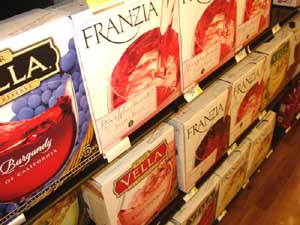
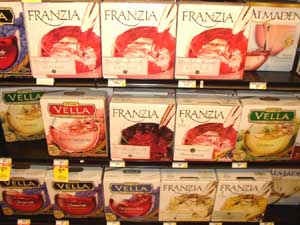
Can boxed wine transcend its trailer trash rap?
Published Thursday, 11-Sep-2003 in issue 820
A handful of European and Australian vintners are facing an enormous U.S. marketing challenge that will be more difficult to conquer than convincing zealous Americans to guzzle French wine again.
The ridicule and scorn that boxed wine has endured since the early 1980s is something that could take years to erase, although France, Germany and Australia are giving it their best shot by peddling some decent vintages contained in connoisseur-defying cardboard and plastic. And we’re not talking about those candy-sweet blushes and knockoff Chablis available at Long’s Drugs.
Australia’s BRL Hardy, for example, has begun encroaching on U.S. soil with a decorous 2002 Chardonnay and 2001 Shiraz, both packaged in five-liter airtight bags that are tucked into sturdy boxes with pull spouts attached. They’re priced at about $16 each. The winemaker’s selling pitch relies partly on a marketing statistic that others like it will need to boost sales, claiming that one in five Americans is currently “using the spout.”
Consumers look at these boxes and start making judgements. The data, however, pales in comparison to Europe and Australia. In England and Norway bag-in-the-box wine claims a third of the wine market. And in the land down under, where the utilitarian concept was supposedly invented — it’s 50 percent.
According to David Derby of San Diego’s WineSellar, boxed wine has its advantages. “The quality has gotten better. And there is less oxidation because the bag compresses as you take from it. Since no air gets inside, the wine lasts a whole lot longer.”
Convenience is the second draw. Derby cites a newly released Bourgogne Blanc from France called Jurassique, which comes in a compact three-liter box (the equivalent of four bottles). The wine is easily transportable for picnics at glass-prohibited beaches and park grounds — and it’s been rated as one of the best vintages to come out of Chablis, Burgundy, in decades. But according to Stephanie Wilcox, a broker for Grapevine Wine Company in Orange County, the product has yet to reach San Diego retailers.
Derby’s reason for not carrying it remains a lack of space — the most common physical hurdle that producers of boxed wine generally face among specialty storeowners. A popular American vintage called Delicious Red by Gallo, for instance, comes in a space-eating, five-liter box that many exclusive wine merchants simply won’t accommodate until consumers overcome their insecurities over the boxes.
And there is still the fact that wine drinkers must punch holes in the bottom ends of the boxes and fish out their spouts before dispensing. Bottle-and-cork loyalists for the most part have difficulty taking the process seriously regardless how fine the wines are inside.
Wilcox agrees that the quality of boxed wine has “gone up” over the past couple of years — though recognizes the image problem. “Consumers look at these boxes and start making judgements,” she adds. “I don’t think we’ll see a growth in the market until high-quality winemakers start coming up with more attractive labeling, such as the attractive green boxes created for Jurassique.”

|
|
Copyright © 2003-2026 Uptown Publications