


-
- Same-sex marriage Mayor Gavin Newsom poised for second term
- No tricks or treats at annual street party in the Castro
- Michigan case centers on gay workers’ benefits
- Church ordered to pay $10.9 million for funeral protest
- Gays still barred, army marks record low level of recruits
- Lambda Legal helps former LAPD sergeant reach settlement
- National News Briefs
- World News Briefs
Arts & Entertainment
Nine Lives’ stars sound off
Published Thursday, 08-Nov-2007 in issue 1037
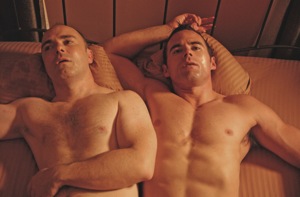
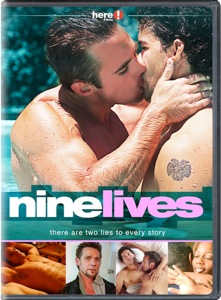
With the recent release of the DVD, Nine Lives, home audiences have an opportunity to view an ensemble movie filled with characters whose lives interconnect on a fundamental level during the course of one day.
Nine Lives captures a cinematic slice of life with glimpses of the GLBT culture’s extremes, and its depiction of what it means to be gay in modern society. From an HIV-positive man reflecting on his life, to an unhealthy, controlling relationship that drives one man into an affair with a pool boy and points beyond, Nine Lives delivers an unflinching look at these different facets.
The Gay and Lesbian Times chatted with two key contributors to the film, writer and actor Michael Kearns (who also stars in the film as Ronnie, the HIV-positive character) and actor Steve Callahan, who portrays Corey (the character who has the affair).
Nine Lives is based on Kearns’ play Complications. The initial idea to write the play came after the terrorist attacks on Sept. 11, 2001.
“[9/11], that was the springboard for the first character,” Kearns said. “In this case I started with the character I play, Ronnie, and all sorts of things started coming up when I started writing that character–like other disasters, like war or AIDS and how there were similarities, in the terms of lives lost, and inexplicable loss and coping, and the complicatedness of losing a number of people in a way that is so devastating to so many people, and how it reverberates.”
Callahan was also involved in the play, but on the acting front, and was drawn to the material because of the subject matter it encompassed. He explained the innocuous beginnings of the play’s shift from the stage to celluloid.
“The play is nine monologues, and so I played the same character in the play and just did a monologue,” Callahan said. “And Dean Howell, who directed the movie, he was an actor in the play also. The whole time we were doing it (the play), he kept saying; ‘Wow, this would make a great movie, I really have this vision of opening up the stories.’ And, he wouldn’t let up, but then once the play was over, he talked to Michael about getting the rights to it and adapting it into a screenplay.”
Kearns added his two cents worth on that process, saying he gladly relinquished a degree of artistic control.
“I didn’t envision a film, and I would have a hard time envisioning a film,” he said. “I’m such a person of the theater; my theatrical background has been so much about words, not about pictures.
“So, I totally turned it over, I mean I worked on the words part of the film, but I had little to nothing to do with his (Howell’s) artistic vision, which I thought was brilliant. It made the movie a completely different experience than the play was, neither of which was better than the other, just different.”
The role of Corey called for Callahan to access parts of himself, which proved to be both difficult and easy as he found a splintered kinship with the character he plays.
“Corey in the movie obviously got condensed down from the play, where there is more back story to him,” Callahan said. “But, Corey’s story is that he came from the Midwest, got on a bus, came to L.A. with visions of becoming a big Hollywood actor, and he immediately got sucked up by Daniel, this Hollywood producer, and then it became a very closeted relationship, and he began to suffocate.
“And, I’m also from the Midwest I’m from Ohio, and came to L.A. with those big eyes and that, ‘Yes, I’m ;going to make it; here I come.’ So, I related to that aspect of it, but that’s where it ends. I’ve never been closeted, never been stuck in that sort of relationship or anything like that.”
Nine Lives has been praised for its gentle execution of sexually graphic scenes, something that both men agree is integral to the plot.
“When we did the play, it’s just monologues, and we just talk about it,” Callahan said. “So, that’s one of the things that came about when they decided to turn it into a movie – do you just have the sex scenes happen off-camera, how graphic do we get?
“And Dean, the director, he really sort of felt like what this movie is, is a movie about nine sexual encounters. It’s the connections made through these nine encounters, but, it would be kind of silly to film a movie about nine sexual encounters and not show them. And, so he really wanted it to be different he wanted it to be a little graphic. He wanted the audience to sit back a little and see something a little more raw, a little more graphic than they were used to seeing in a film.”
Kearns delved into the reasons behind the characters’ actions.
“The film makes it certainly steamier than the play ever could be,” said Kearns in regards to the sex on screen, which holds a deeper meaning. “I think what that is, I’m not sure. I think some of it is tender, but the word I would use even before tender is that it’s human. The sexuality, no matter how extreme it might be, it’s based in human behavior and psychologically valid human responses and instincts.”
That underlying theme of people connecting on a different level is what propels the film’s story, but there are other nuances that both feel are the film’s strongest message.
“I would like to think that the film’s message is ‘don’t judge,’” Kearns said. “I’m someone who creates dramatic situations, and I hopefully create situations where the audience is put in the position of looking at something differently than they might have before they went into the theater.
“And also, I want to entertain. So while entertaining, I hope that the audience can see the humanity that exists in different permutations of gay male sexuality, and not be so harsh and judgmental.”
Callahan sees the project as a way to generate topical discussion in smaller cities.
“When we would take it into the smaller cities in the South and the Midwest, places like that, it became much more of an issue film,” Callahan said. “And, people were talking about AIDS and the storyline about the guy on the down low, and I think it’s really interesting that the movie gets people talking; it’s fun to be in a movie that people have a strong reaction to, people want to talk about the movie afterwards.”
Callahan can next be seen in the film, East Side Story, being released on DVD Dec. 4.
As for Kearns, his real life role as a dad “supercedes everything else” that he has achieved career-wise. But, there is one distinction that may not be listed on his acting resume per se, which he takes great pride in nonetheless.
Kearns has the distinction of being one of the first out actors during the ’80s, a time when that was particularly verboten due to the scare surrounding the AIDS epidemic. Kearns had this view on gay actors staying in the closet nowadays.
“Well, I think it’s a financial choice,” he said. “They’re closeted for the same reason that Rock Hudson was closeted; this is nothing new, they’ll make more money if they are in the closet, end of discussion. Eventually, it kind of catches up with most of them, they are going to get caught, everybody gets caught.
“So, I don’t know what the money is buying them, or the fame or prestige, it’s all bullshit. I mean just be who you are, first and foremost, no matter if you are an actor, or a graphic artist or a delivery man, be who you are.”
Nine Lives is available on DVD via Genius Products, and you can view the trailer at www.ninelivesmovie.com/video.htm. 
|
|
Copyright © 2003-2026 Uptown Publications