

-
- U.S. elections: A referendum on men behaving badly?
- New Jersey schools adjust to transgender teacher
- New Jersey recognizes same-sex unions
- Gay GOP politicians see offices vacated
- Studds’ spouse denied U.S. death benefits because he’s gay
- Marriage amendment opponents maintain money lead
- National News Briefs
- World News Briefs
arts & entertainment
Gaywatch
Oh, the horror!
Published Thursday, 26-Oct-2006 in issue 983
Ever since horror movies slipped into our collective consciousness, gay audiences have had an affinity for the often-homoerotic genre: a dead man wanting to suck your, um, blood; werewolves sprouting unwanted thatches of hair; and who could forget the misunderstood Frankenstein monster being chased by torch-wielding villagers simply because he is “different.” How could that resonate with us?
Just in time for Halloween weekend, here’s a taste of such instances from over the years.
Universal appeal
Horror films first became a movie dietary supplement in the 1930s, when Universal unleashed a slew on onscreen monsters that gay audiences could draw an eerie parallel with. There is the aforementioned Frankenstein monster, who just wanted to be loved but ended up being feared because of what he was. And he was built by another man made out of spare parts. Hello, gay!
Its sequel, The Bride of Frankenstein, was an exercise in gaiety. Directed by James Whale (he was the subject of Gods And Monsters), there was a certain gay air that permeated each scene, no matter what was transpiring on the screen; from star Colin Clive’s nervous nelliness to Dr. Pretorius (Ernest Thesiger), who was really into giving the bride her ultimate makeover! Just call him “Queer Eye for the Dead Gal.”
In 1932’s The Mummy, it was surmised that the titular bandaged ghoul may have been buried alive because, as one of the films heroes puts it, “he got too gay with one of the vestal virgins.” If that were the case, you would think Im-Ho-Tep (Boris Karloff) would have asked to be buried in something a little more fashionable, like, say, chiffon!
The Invisible Man is an interesting glimpse inside the coded world of 1930s Hollywood. Since it could not be directly stated if there was a gay character on screen, there were other ways of informing the audience that a character might be queer. Having a character interested in flowers and all things horticulture was one way to do this, believe it or not! And the invisible man loved tiptoeing through the tulips.
It’s no secret that Boris “Frankenstein” Karloff and Bela “Dracula” Lugosi had a huge rivalry off screen, but when they brought that love-to-hate you energy to 1934’s The Black Cat and 1935’s The Raven, the sparks flew for other reasons. Both films have a huge homoerotic vibe running throughout.
Suck it
Dracula’s Daughter (1936) featured Gloria Holden as Countess Marya Zaleska, who wanted to be “cured” of her vampirism to “live a normal life; think normal things.” Needless to say, this vampire is widely associated with being screendom’s first of the lesbian variety. And she was catered to by a manservant who was the biggest queen this side of Transylvania!
Following in those footsteps almost 50 years later were Susan Sarandon and Catherine Deneuve in 1983’s The Hunger, which was a lot clearer about the queer.
Fright Night had four gays for the price of one ticket. The vampire, Jerry Dandrige (Chris Sarandon), and his manservant, (nudge, wink) Billy Cole (Jonathan Stark), were obviously a couple. Their neighbor, Charlie (William Ragsdale), seemed a little too preoccupied with the goings on of his neighbors, even if they were creatures of the night. A pre-out-and-proud Amanda Bearse (“Married With Children”) played the hero’s love interest, and then there’s Roddy McDowall as Peter Vincent… ’nuff said.
The Lost Boys sported black leather and earrings, and one of its stars, Kiefer Sutherland, rocked a Miss Clairol Blonde #5 hairdo, with plenty of product holding it in place. The gayest thing about the film was Corey Haim; he had a poster of Rob Lowe in a half shirt on his bedroom wall, wore a shirt that proclaimed that he was born to shop and sang a song that he “ain’t got a man” while taking a bubble bath!
Interview with the Vampire could be viewed as Brad Pitt’s coming-out story. Hey, hold up, it’s only on film. Sigh. Pitt’s character, Louis, is brought into a new world and must acclimate himself to these new “lifestyle choices” after receiving one hell of a hickey from Tom Cruise’s Lestat. The pair even adopt a little vampire girl, Claudia (Kirsten Dunst). Here’s a fun homophobic fact about the film: At one point, to skirt the obvious homosexual leanings of its two main characters, the filmmakers were going to make Pitt’s character female. And they were going to cast Cher in that role. Yup, that would have made it less gay!
I’ll take Campy Flicks for 500, please
The Leech Woman’s tagline was: “Forever young! Forever deadly! She lived off the life blood of her male victims.” This 1960 flick starred Colleen Gray and a post-Incredible Shrinking Man Grant Williams. Long before Botox, a gal had to go to great lengths to appear young-looking; to remain youthful, Gray had to murder people and also had to take a serum that (plot spoiler alert) turns her into The Leech Woman. The Wasp Woman’s Susan Cabot faced a similar predicament when she turns into a – well, a Wasp Woman, duh!
Attack of the 50 Ft. Woman was the ultimate revenge tale for poor cheated-upon and duped Nancy (Allison Hayes). After an encounter with aliens, she has a huge growth spurt, becoming the titular 50 Ft. Woman, and goes about exacting her vengeance on those who have done her wrong. You go, girl.
The teenagers in the film Teenagers from Outer Space (1959) make the cast of “Beverly Hills, 90210” look like they could be at home on Sesame Street! In this tale of interplanetary conquest, spaceman Derek (David Love) seems a tad more interested in cinching his spacesuit with a kicky belt than giving in to the obvious advances of the severely banged (of the hair variety) and smitten Betty (Dawn Bender). Of note, the film’s writer and director, Tom Graeff, and its star, Love, were lovers off screen.
William Castle was the poor man’s Alfred Hitchcock, but his brand of thrillers had a big appeal for the gays. Some of his most notable films starred Vincent Price and Joan Crawford. The Night Walker (1964) starred real-life lesbian Barbara Stanwyck, who had the manliest scream this side of Bea Arthur.
Let’s hear it for the boys
Horror movies can have a little somethin’ somethin’ in the eye candy department. Who can forget Speedo-clad Kevin Bacon in the first Friday the 13th? I can’t! But you’ll have to wade through three more sequels before you’ll get an eyeful of actual bare butts. In Friday the 13th: The Final Chapter (yeah, sure), there is a memorable skinny-dipping scene.
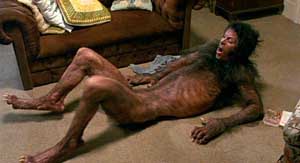
An American Werewolf in London (1981) had numerous scenes of a nekkid “that Dr. Pepper guy” David Naughton pre- and post-werewolf.
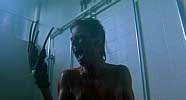
Arguably one of the gayest horror movies ever was A Nightmare on Elm Street Part 2: Freddy’s Revenge (1985). For starters, its star, Mark Patton, could have given Barbara Stanwyck lessons in how to scream like a girl! Secondly, at one point in the film he is tackled on a baseball field by a hot jock (Robert Rusler) and has his sweats pulled down, exposing his jock strap-clad butt. Thirdly, his gym teacher is into S&M and ends up being killed in a fetish-type way. And, of course, there’s Freddy Krueger (Robert Englund) himself, with his pithy comebacks.
Cut. Print. That’s a wrap
Whether you like your homosexuality and horror films coded or blatant, there are scads of flicks for you to check out this Halloween. Until next time, that’s all of the news that’s fit to print.

|
|
Copyright © 2003-2026 Uptown Publications